
Why first-of-a-kind climate projects don't get financed, and what would change that.
A first-pass causal model of green steel financing, built with practitioners on Anthos and presented at Climate Week, September 2026.

Reach out if you'd like to support this initiative.
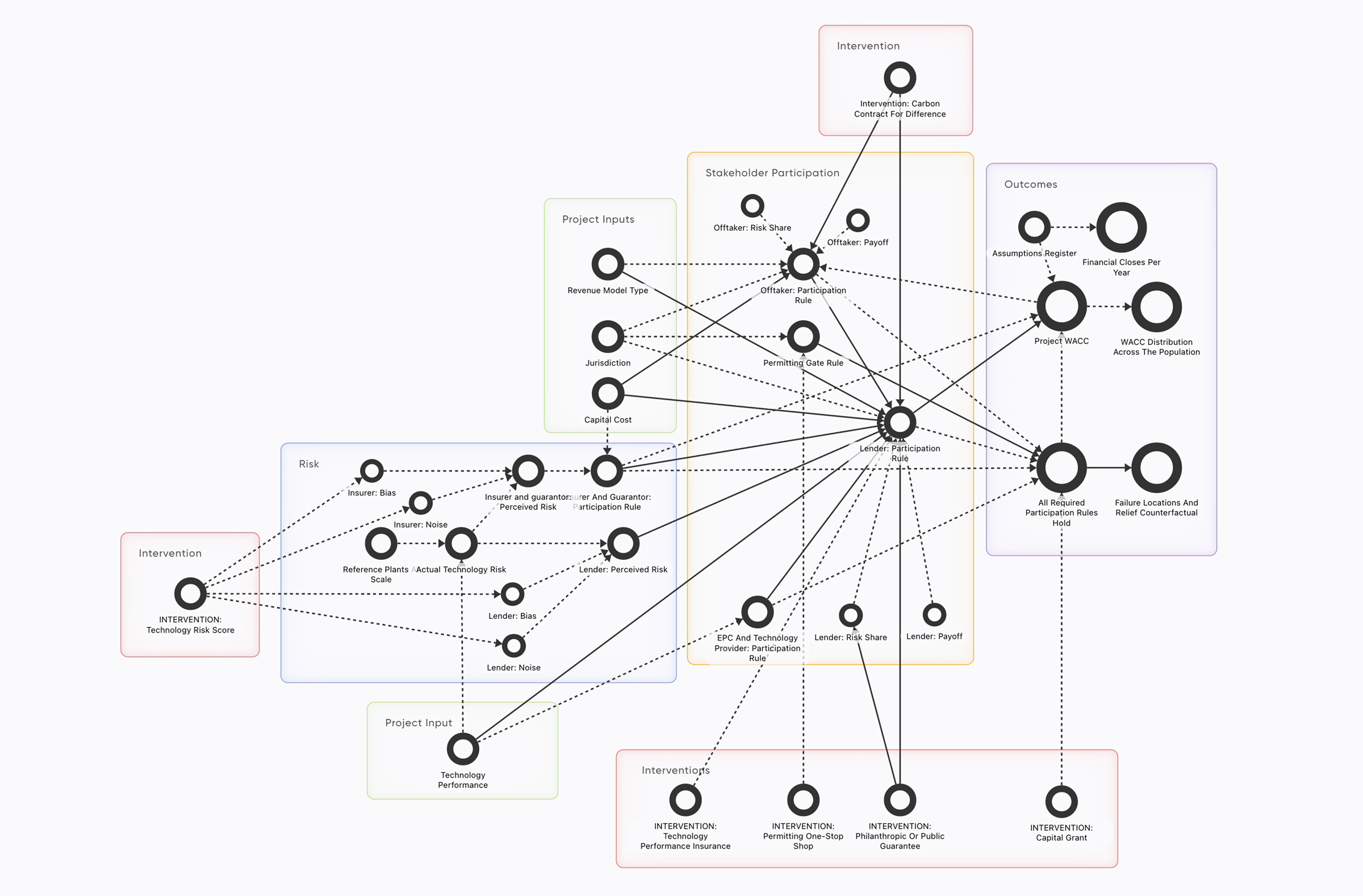
A first-pass causal model of green steel financing. Seven parties each apply their own test, and the model runs those rules across 100,000 simulated projects to see which get financed.
None of the 28 near-zero-emission primary steel plants tracked worldwide is operating yet. A project is financed only when every party says yes, and none of them can see the others' tests.
commercial-scale, near-zero-emission primary steel plants tracked worldwide are operating.
of those 28 have reached a final investment decision, the point where the money is committed.
simulated projects are financed in the model's baseline run of 100,000 projects.
Plant counts: Mission Possible Partnership, Global Project Tracker, June 2026 release, data current as of April 2026. The counts are a snapshot, not a failure rate, because some projects are still early. Model figures: run of 2 September 2026.
Many projects are announced. Few are built.
Green steel costs more to make, but cost is only part of the story. A first-of-a-kind project is financed only when every party says yes. Each applies its own test, and none can see the others' tests. The problem is partly economic and partly one of coordination.
Public trackers show that projects stall. They do not show where in the process they stall, or who said no. That is the question this model sets out to answer: how do more projects get built, at a lower cost of capital?
Seven parties, seven rules, one model.
We wrote down how seven key parties make their decision, as short rules in which every number is sourced or marked as an estimate. Each rule returns a decision and a price. We connected the rules and ran them across 100,000 simulated projects that differ in cost, country and technology maturity. Policy instruments are switches, each changing one named number in one rule.
Does the project return justify the development cost?
Is the price within what I will pay?
Does the cash cover the debt service?
Does the return clear my hurdle?
Can I price the technical risk?
Is the permit granted, and the support awarded?
Will I guarantee completion and performance?
Three early findings.
Every instrument helps. None helps much.
Switched on alone, each instrument adds a few projects to the baseline of 8 in 100.
Additional projects financed per 100. The differences are small and rest on estimates, so the order is not yet reliable.
Most projects fail more than one test.
Removing one obstacle leaves projects blocked by another. That is why each instrument does so little: each acts on a single test.
Additional projects financed per 100. The two alone add up to 24. These are thought experiments, not instruments.
The answer depends on numbers we need to pin down.
Some inputs are estimates because suitable data does not yet exist, and they move the result a long way.
Projects financed per 100 at the lowest and highest plausible value of each input.
We checked the model against six published figures it was not fitted to. Five agree. One does not: the model says about 59 in every 100 failed projects fail first at the buyer's price test, while studies of cancelled projects put that at 10 to 30. We think the main cause is one estimated number, the premium a buyer must pay. So this shows what the model can test. It is not yet advice on where to put money.
What the platform made possible.
The model was built and run in a few weeks by someone who had never built a causal model before. We estimate an expert working by hand would have needed at least ten times as long.
Because every rule is readable, people who do not write code can question each one and argue about the links between them, with the evidence shown alongside. We also built the model a second time in plain code. The first comparison caught an error that had inflated the cost of capital by 4 percentage points.
